AI Evaluation / v0.1
Why OpenRouter Fusion Benchmarks Can Be Misleading
OpenRouter Fusion’s high scores are better understood as search amplification plus verifier selection, not as low-scoring models fusing into frontier-level intelligence.
Why OpenRouter Fusion Benchmarks Can Be Misleading
OpenRouter recently released Fusion and packaged it with a highly shareable headline: “Surpassing Frontier Performance with Fusion.” In the official chart, several models with lower individual scores are combined, and the resulting score exceeds GPT-5.5, Claude Opus 4.8, and even approaches or surpasses Claude Fable 5. This result is easy to spread as one sentence: after fusing low-scoring models, the system produces intelligence beyond frontier models.
But that is not the most accurate interpretation.
More accurately: Fusion is not an intelligence breakthrough. When a scoring or acceptance mechanism exists, it is a form of mathematical hacking that improves hit rate through multi-path reruns.
Here, “mathematical hacking” is not a pejorative. It is an engineering description: Fusion does not make a single model smarter. It increases the number of candidate answers, changes reasoning paths, and then uses a judge/verifier to filter and synthesize them, raising the probability that the final result matches the scoring standard.
Why the Official Benchmark Chart Is Easy to Misread
The title of OpenRouter’s official article is “Surpassing Frontier Performance with Fusion,” and the opening summary makes three claims: panel models consistently outperform individual models, frontier panels can reach beyond-frontier performance, and budget model panels can surpass frontier models.1
The official benchmark chart is:
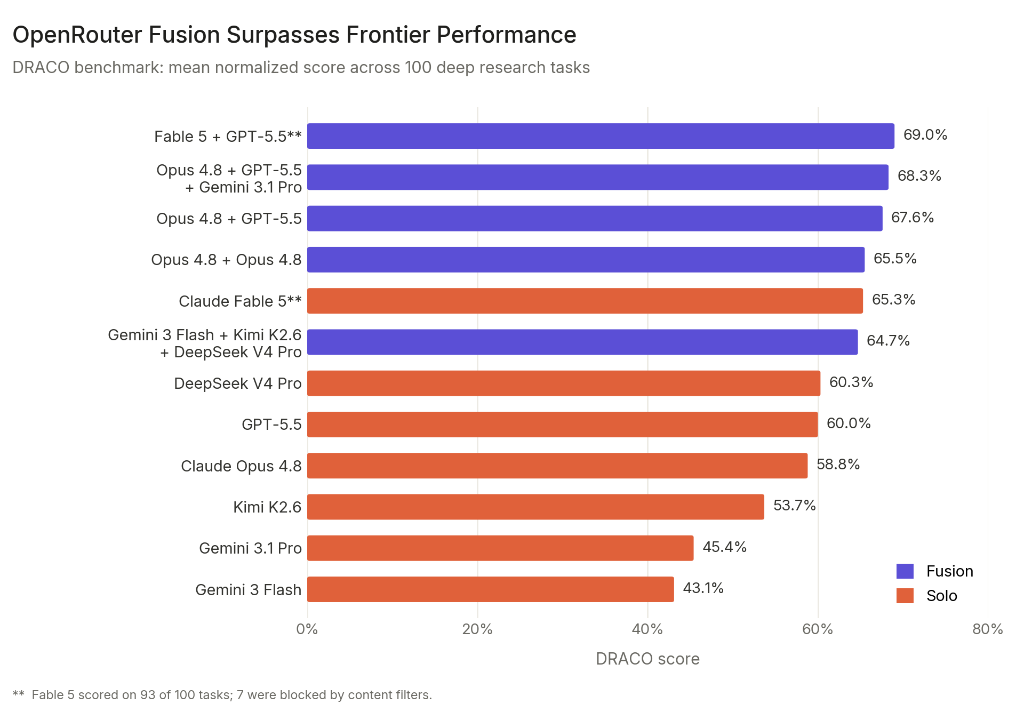
The most shareable comparisons in the chart are:
Fable 5 + GPT-5.5, synthesized byOpus 4.8, scores 69.0%.Opus 4.8 + GPT-5.5 + Gemini 3.1 Pro, synthesized byOpus 4.8, scores 68.3%.Gemini 3 Flash + Kimi K2.6 + DeepSeek V4 Pro, synthesized byOpus 4.8, scores 64.7%.- Solo
GPT-5.5scores 60.0%,Claude Opus 4.8scores 58.8%,Kimi K2.6scores 53.7%, andGemini 3 Flashscores 43.1%.2
The chart has a strong visual effect: the purple Fusion bars are almost all above the orange Solo bars, so readers easily form an intuitive judgment: mixing models produces higher intelligence.
But what the chart actually demonstrates is not “intelligence fusion.” It shows that multiple generations, multi-path search, and synthesis can indeed improve scores under certain scoring mechanisms.
What Actually Works Is Not “Fusion,” but Repeated Search
OpenRouter’s official description of the Fusion process is not mysterious: the same question is sent to multiple panel models, each model answers in parallel; the judge model reads those answers and organizes consensus, contradictions, coverage gaps, unique insights, and blind spots; finally, an outer model generates the final answer.3
This is not model weight fusion, nor is it training a stronger new model. It is external orchestration. It is closer to:
Multiple generators produce candidate answers, and a judge/verifier selects or synthesizes the parts more likely to be correct.
If a task has a single-run success rate p, and you run it n times, then as long as the paths are not completely identical and a reliable mechanism can identify the correct answer afterwards, the probability of hitting the correct solution at least once rises:
1 - (1 - p)^nReal repeated runs are not fully independent, so this ideal formula cannot be applied directly. But the direction holds: as long as candidates differ in path, running more attempts increases the probability of producing a better answer.
This is also why several low-scoring models can produce a high score when combined. A low score for a single model does not mean every judgment it makes is wrong. It may miss some facts, cite insufficiently, structure poorly, or go off-topic on some questions. When multiple models run together, model A may provide facts, model B may provide structure, model C may provide citations, and the judge then stitches them into an answer that better fits the scoring rubric.
This is not “several low-scoring intelligences combining into a high-scoring intelligence.” It is:
Multiple unstable candidates being recombined into a better answer under one scoring standard.
The Key Evidence: The Same Model Fused With Itself Also Improves Significantly
OpenRouter’s article provides a very important clue: Opus 4.8 + Opus 4.8, synthesized again by Opus 4.8, scores 65.5%, while solo Opus 4.8 scores 58.8%. In other words, a panel made from the same model paired with itself also improves by 6.7 points.4
This matters a lot.
If Fusion’s main gain came from complementary differences between model architectures, then self-fusion with the same model should provide limited benefit. But the official result shows that repeated runs of the same model can also significantly improve performance. This suggests that a large part of Fusion’s gain comes from:
- sampling the same question multiple times;
- different runs producing different reasoning paths;
- different tool calls and source choices;
- the judge/synthesizer extracting the content that best fits the scoring standard from multiple candidates.
In other words, the core of Fusion is not “multi-model intelligence fusion,” but search amplification.
This Is Mathematical Hacking When a Verifier Exists
“Mathematical hacking” can be understood this way:
The generator can be unstable, but the verifier must be reliable.
When a reliable acceptance mechanism exists, repeated reruns are extremely effective. For example:
- whether code compiles;
- whether unit tests pass;
- whether SQL query results satisfy assertions;
- whether a benchmark score improves;
- whether a proof checker accepts a proof;
- whether output satisfies a clear format and constraints.
In these cases, the model is only a candidate generator. The verifier is what actually determines the result. Multi-model, multi-prompt, multi-agent, and repeated rerun strategies all expand the search space. As long as the verifier is reliable, the system can keep trying until it hits a correct answer.
So it is not surprising that Fusion can improve scores on a task like DRACO. DRACO is a deep research benchmark with 100 deep research tasks covering academic research, finance, law, medicine, technology, UX design, general knowledge, needle-in-a-haystack retrieval, personalized assistance, product comparison, and more; its scoring criteria include factual accuracy, analytical depth, expression quality, and citation quality.5
Deep research tasks are naturally suited to “multiple people search, multiple people draft, one editor synthesizes.” As long as the scorer can identify which facts, citations, and structures better match the rubric, synthesizing multiple candidates can produce obvious gains.
But It Is Much Less Useful in Real Projects
The difficulty in real software projects is often not “generating a few more candidate solutions,” but that “the acceptance criteria themselves are hard to establish.”
Many problems in complex projects cannot be judged simply by an automatic verifier:
- whether the requirement was truly understood;
- whether the architecture is maintainable long-term;
- whether the UI experience matches user expectations;
- whether a refactor breaks implicit business rules;
- whether test coverage is sufficient;
- whether regression risk was discovered;
- whether the solution fits the team’s future direction.
These acceptance standards themselves depend on human engineering experience, or on stronger model capabilities to construct. As a result, Fusion’s advantage declines significantly.
In real projects, the most valuable thing is not “multi-model mutual review,” but building a complete loop:
Task definition → acceptance criteria → automated tests → failure feedback → multi-path rerun → evidence chain accumulation
Without this loop, Fusion only makes answers more complete, more confident, and more expert-like; it does not necessarily make them more correct.
OpenRouter itself is more cautious in its FAQ: Fusion is not a drop-in replacement for coding models. It is better used as a server tool that a coding model can choose to call for architecture decisions, best-practice research, and other questions worth spending more time and cost on.6
The Real Problem Is Not Fraud, but Narrative Compression
OpenRouter’s official experiment is not fraud. It shows a real phenomenon: on open-ended tasks like deep research, multiple models, multiple paths, and synthesis can indeed improve scores.
The problem is that this result is very easy to compress during propagation into:
Low-scoring models fused together to produce higher intelligence.
That statement is misleading.
A more accurate expression would be:
On tasks with a scoring or acceptance mechanism, multi-path generation and synthesis can increase the probability of hitting the scoring standard.
These two statements may look similar, but they mean completely different things. The former attributes the gain to “intelligence fusion”; the latter attributes it to “search amplification + verifier selection.”
Conclusion
OpenRouter Fusion’s high scores are not mysterious.
It uses a simple mechanism:
Generate candidate answers along multiple paths, then use filtering and synthesis under an acceptance standard to increase the probability of hitting the correct result.
This is “mathematical hacking”: the model did not become smarter; the system spent more compute budget, explored more paths, and used the scoring mechanism to select a better result.
Fusion has real value in open-ended tasks such as deep research, proposal review, source synthesis, and risk discovery.
But in real engineering projects, its value is much lower, because the hardest part is often not generating candidates, but building a reliable verifier.
So the more accurate judgment is:
Fusion is not intelligence fusion. It is search amplification. Its ceiling is not determined by the number of panel models, but by the reliability of the verifier.
Original References and Screenshot Sources
Footnotes
-
OpenRouter Blog, Surpassing Frontier Performance with Fusion, 2026-06-12. The official title and three opening summary claims appear at the beginning of the article. https://openrouter.ai/blog/announcements/fusion-beats-frontier/ ↩
-
OpenRouter official benchmark chart and table: DRACO benchmark scores for Fusion and solo configurations. Official image link: https://openrouter.ai/blog/images/blog/fusion-benchmark-chart.png ↩
-
OpenRouter’s description of the Fusion process appears in the “One API call that fuses the best output of multiple models” section of the official article, and in the Fusion API docs. https://openrouter.ai/docs/guides/routing/routers/fusion-router ↩
-
OpenRouter official article, “Significant boost from fusing a model with itself”: Opus 4.8 partnered with itself scores 65.5%, while solo Opus 4.8 scores 58.8%. https://openrouter.ai/blog/announcements/fusion-beats-frontier/ ↩
-
DRACO benchmark paper: Evaluating Deep Research Performance in the Wild with the DRACO Benchmark. https://arxiv.org/abs/2604.06281 ↩
-
OpenRouter official FAQ, “How should I use Fusion for coding?”: Fusion is not a drop-in replacement for coding models, but a server tool that a coding model can choose to call. https://openrouter.ai/blog/announcements/fusion-beats-frontier/#614-update-faq-from-the-launch ↩